How do I manage IT across multiple retail locations? Standardize on one store technology blueprint — network, POS, cabling, and security — deployed consistently at every location, managed centrally rather than store by store. Centralized networking (SD-WAN), unified POS reporting, consistent PCI DSS segmentation, and a single IT support relationship replace the patchwork of local vendors and inconsistent configurations that develop naturally as a retail chain grows one store at a time.
Here's the problem almost every growing retail chain runs into, usually without noticing it happening in real time: each new store gets set up a little differently. A different installer, a slightly different network configuration, a POS deployment that technically works but doesn't quite match the others, a local IT contact who knows that one store's quirks and nobody else's. Multiply that by twenty, fifty, or two hundred locations, and you don't have a retail chain with consistent IT — you have a spaghetti of vendor contracts and inconsistent infrastructure that gets harder and more expensive to support every year.
The Compounding Complexity Problem
Every new store is, in effect, a new network, a new POS deployment, a new support relationship, and a new PCI compliance scope. Individually, none of these is unmanageable. Multiplied across dozens or hundreds of locations without a deliberate standard, they compound into exactly the kind of operational drag that slows expansion and inflates support costs — because every technician who walks into a new store has to relearn how that specific location is configured, rather than already knowing the answer from having supported an identical setup elsewhere.
The fix isn't a better point solution at each location — it's architectural: one standardized store blueprint, deployed consistently across every site, centrally managed, and scaling cleanly as the brand grows. The goal, plainly stated, is that store #50 should look like store #1, just newer.
Centralized POS: One System of Record, Not One Per Store
At a single location, a POS system just needs to capture sales, manage orders, and process payments — table-stakes functions most systems handle adequately on their own. At multiple locations, the POS has to do considerably more: push consistent sales data into a central reporting structure in real time, support centralized menu or catalog management so a pricing change doesn't require updating every store individually, and produce location-level reporting that gives leadership genuine comparative visibility without manual consolidation across spreadsheets.
This is also where inventory management shifts fundamentally. A centralized POS gives real-time visibility into stock levels across every location from a single dashboard, enabling automated stock transfers between stores based on demand rather than each location operating as its own isolated inventory silo. The more advanced version of this — increasingly standard in 2026 — is treating inventory as a single network: supporting store-to-store fulfillment and "sell from any location, fulfill from the best one" logic that reduces lost sales without requiring more total stock sitting across the chain.
Pricing and promotions need the same centralized-with-local-flexibility structure. A strong multi-location approach starts with a clear architecture defining what's global (core pricing, MAP policy, standard discount rules) versus what's local (regional pricing, clearance events, grand-opening promotions) — without collapsing into a patchwork of store-by-store exceptions that nobody can audit consistently.
Centralized Networking: The Infrastructure Layer Most Retailers Underinvest In
Network infrastructure is where multi-location retail complexity gets the most expensive to fix after the fact, and the most valuable to standardize upfront. Centralized networking — using SD-WAN specifically — lets POS transaction traffic get prioritized over background processes, with automatic failover to a secondary circuit if the primary connection degrades. Done well, this maintains 99.99% uptime for payment transactions even during an ISP outage at an individual store, which matters directly to revenue in a way that most other IT investments don't as visibly.
Centralized firewall management is the other half of this picture, enforcing PCI DSS network segmentation consistently across every location rather than leaving each store to manage its own security configuration — a gap that's one of the most common sources of compliance exposure in multi-location retail, since a single inconsistently configured store can create chain-wide liability even when every other location is correctly configured.
Centralized management also changes what a new-store rollout actually looks like operationally: pre-configured templates deploy to new stores without requiring local IT expertise on-site, and pre-staging hardware off-site reduces installation time from days to hours. Remote management eliminates most truck rolls entirely, cutting travel costs and reducing the time stores spend waiting for on-site support for issues that don't actually require a technician physically present.
Physical Infrastructure: Cabling Standards Matter More Than They Seem
It's easy to treat cabling as a commodity decision, but it's one of the few infrastructure choices that's genuinely expensive to get wrong. Cat 6a cabling gives retail stores enough bandwidth headroom for higher-resolution security cameras and modern POS systems without needing a rewire within a few years — it costs more upfront than Cat 5e, but avoids the repeat buildout cost of upgrading cabling again as camera resolution and POS bandwidth needs increase. Done consistently across every location, this also pays off operationally: a technician walking into store number seven already knows exactly where everything is, because it matches every other store in the chain.
Planning a Multi-Site Technology Rollout
Whether you're opening new locations or refreshing POS and network infrastructure across existing ones, a successful multi-site rollout requires centralized coordination, phased deployment waves, and site-by-site readiness validation before any technician arrives. Field service coordination is consistently the most common failure point in these projects — site surveys and pre-deployment checklists that catch power, cabling, and access issues in advance prevent the delays that derail so many rollout timelines after the fact.
Timeline expectations should scale with the scope: a large-scale rollout across roughly 500 stores might reasonably take three to six months with proper planning, and phased approaches that group stores by region typically complete faster and with fewer disruptions than attempting simultaneous nationwide installations. Real-time visibility into technician status and equipment tracking — rather than assuming a rollout is on schedule until proven otherwise — is what separates a coordinated deployment from a chaotic one.
Why Vendor Consolidation Matters More Than It Sounds
One of the most overlooked simplifications available to multi-location retailers is working with a single provider across phones, cameras, network cabling, and general infrastructure, rather than managing separate vendor relationships for each. A provider covering all three removes the coordination problem inherent in juggling multiple vendors across multiple stores — and it directly supports the "store #50 looks like store #1" standardization goal, since a single vendor deploying the same blueprint everywhere produces far more consistency than several vendors each executing their own version of "good enough" at different locations.
The Growth Case for Getting This Right
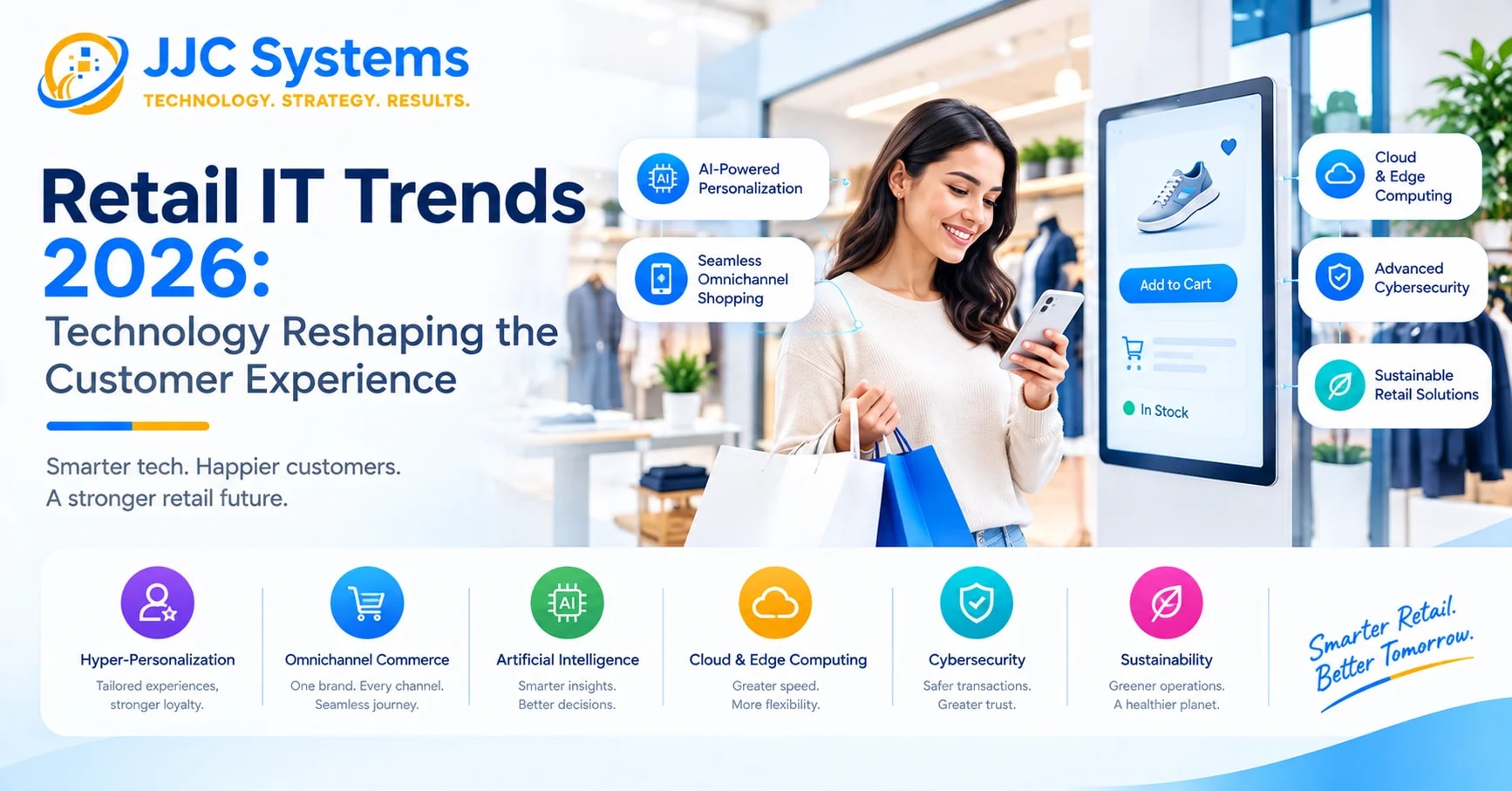
This isn't purely a cost-avoidance conversation. Half of retailers currently plan to open new locations within the next two years, and roughly 68% cite better in-store experience as a key driver for attracting foot traffic to those new locations. Retail infrastructure that scales predictably — where opening store #50 is a known, repeatable process rather than a custom project — directly supports that expansion pace. Retailers still refining their broader technology roadmap alongside this infrastructure question may also find our 2026 retail IT trends overview useful context, since centralized data and infrastructure are exactly what make many of those broader AI and personalization trends actually work reliably at scale.
Frequently Asked Questions
How do I manage IT across multiple retail locations? Standardize on one technology blueprint — network, POS, cabling, and security configuration — deployed consistently at every location and managed centrally. This replaces the patchwork of inconsistent local setups that develops naturally as a chain grows store by store, and it's typically delivered through a single IT provider rather than separate vendors per function.
What is SD-WAN and why does it matter for retail chains? SD-WAN is networking technology that prioritizes critical traffic — like POS payment transactions — over background processes, and automatically fails over to a backup connection if the primary one degrades. For multi-location retail, this can maintain 99.99% uptime for payment processing even during a local ISP outage.
How does centralized management affect PCI DSS compliance across stores? Centralized firewall and network management enforces consistent PCI DSS segmentation across every location, closing the compliance gaps that occur when individual stores manage their own security configurations independently — a common and often unrecognized source of chain-wide compliance risk.
Should every store use the same POS system? Generally yes, for any chain planning to grow beyond a handful of locations. A unified POS gives centralized inventory visibility, consistent pricing architecture, and consolidated reporting — a system that works well for one store often becomes a bottleneck once a chain reaches double-digit locations without this consistency.
How long does a multi-store technology rollout typically take? It scales with the number of locations and complexity — a rollout across roughly 500 stores might take three to six months with proper planning. Phased, regionally-grouped rollouts typically complete faster and with fewer disruptions than attempting a simultaneous nationwide installation.
Is it better to use one IT provider or separate vendors for phones, cameras, and networking? A single provider covering all three generally works better for multi-location retail, since it removes the coordination burden of managing separate vendor relationships across every store and supports consistent, repeatable deployment rather than each vendor executing its own version of the standard.
What cabling standard should new retail stores use in 2026? Cat 6a is generally recommended for any chain planning to open more than one location, since it provides enough bandwidth headroom for higher-resolution security cameras and modern POS systems without requiring a rewire within a few years, despite a higher upfront cost than Cat 5e.
What's the biggest point of failure in multi-site retail IT rollouts? Field service coordination — inconsistent technician quality, inadequate site preparation, and coordination breakdowns across multiple locations cause the majority of rollout delays. Site surveys and pre-deployment checklists that catch issues before a technician arrives address this directly.
Ready to Standardize IT Across Your Retail Locations?
The chains that scale smoothly are the ones where opening a new store is a repeatable process, not a custom project every time. Schedule a consultation with a JJC Systems specialist to talk through standardizing your store infrastructure, or contact our team to map out what a consistent, centrally-managed blueprint would look like across your locations.